The White House has released a domestic policy report regarding stem cell research. It is titled, Advancing Stem Cell Science Without Destroying Human Life and it is a great overview of what we know about stem cell science and some alternatives to using human embryos that are being explored. I am very proud of our President for sticking to his principles on this important issue and for not ignoring the science in the process. Stem cell science is broader than just embryonic stem cell research. There are a number of other sources for human stem cells that do not involve the destruction of nascent human life, many of which have qualities similar to those found in human embryos.
The report also includes an appendix on embryo adoption and another addressing human cloning.
Key Text:
Embryos are humans in their earliest developmental stage. We do not have to think that human embryos are exactly the same in all ways as older humans to believe that they are entitled to respect and protection. Each of us originated as a single-celled embryo, and from that moment have developed along a continuous biological trajectory throughout our existence. To speak of “an embryo” is to designate a human being at a particular stage.
Our nation was founded on the principle that all of us are created equal, and endowed with a right to exist that is shared fully by all humans. There is no such thing as an excess life. And the fact that a human lacks some particular capacity, or even is going to die, does not justify experimenting on that individual, or exploiting him or her as a natural resource. That has long been the standard in medical ethics—as encoded in the Hippocratic Oath, as well as more modern codes like the Physician’s Oath in the 1948 Declaration of Geneva, which states: “I will maintain the utmost respect for human life from the time of conception.”
A policy that defends the inviolability of human life does not preclude the hopeful possibilities of new findings and new therapies. It simply means we must harness the creative powers of our advancing knowledge only to humane and morally balanced means and ends. Amidst today’s dizzying pace of technological innovation, it is worth taking care to make sure that our moral and ethical policies keep up. The biotechnology revolution will bring sound and wholesome human results over the long run only if it is sensibly governed.
The stem cell debate is only the first in what will be an onrushing train of biotechnology challenges in our future. We must establish a constructive precedent here for taking the moral dimensions of these issues seriously. We must make certain we don’t force ourselves into a false choice between science and ethics—because we need both.
 YES! I unfortunately missed Sen. Brownback’s speech to the March for Life crowd yesterday. I wanted to watch the whole thing but I was running around most of the day and didn’t get to catch any of it. The Washington Post reports that the Presidential hopeful was more than
 Deroy Murdock has a critique of former mayor, Rudy Giuliani’s
  I don’t think the White House could have chosen a better spokesperson. Tony Snow is fiercely accurate and unafraid to take on media criticism. In a recent exchange with one reporter, Snow
 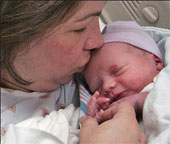 Meet Noah Markham and his mother Rebekah. Two weeks after hurricane Katrina hit, 1400 embryos were rescued from a flooded New Orleans hospital. Noah was
  It seems that both American and Canadian OB-GYN doctors have agreed that all pregnant women not just those over 35, should